
September 2026 · 8 min read · Yard & Outdoor
Last October I spent a full Saturday afternoon raking our quarter-acre lot. Three hours, two blisters, and one very sore lower back later, the lawn was clear. A week later it was buried again, because that's how October works. By the third weekend of the season I was standing in the yard at 8 AM with a rake, genuinely questioning my life choices.
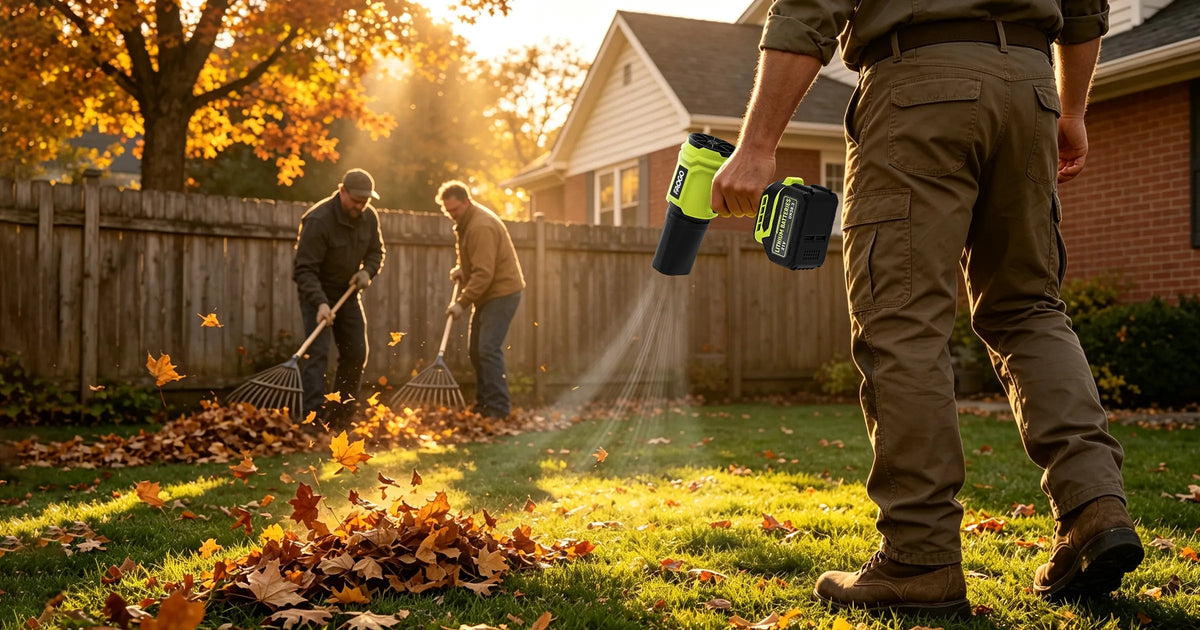
A neighbor two doors down was doing the same job with a handheld blower. I watched him finish his lawn — same size as mine — in about forty minutes. That's roughly when I stopped believing raking was some kind of fall tradition worth keeping.
This is the method I settled on after a full season of testing. It's not complicated, and none of it requires spending more than you would on a decent rake and a pair of gloves anyway.
Why raking is the slowest way to move a leaf
A rake moves leaves one drag at a time. The tines catch a few dozen leaves, you pull them a few feet, and you repeat that maybe five hundred times over an afternoon. Every leaf travels the full distance to your pile at the speed of your walking pace, with your back supplying the energy.
Air is different. A focused airstream sweeps a three-to-four-foot-wide path and keeps the leaves moving the entire time you're walking. You're not picking anything up — you're redirecting what's already loose and dry. The same coverage that takes a rake twenty passes takes a blower five.
The general claim you'll see on blower product pages is "three times faster than raking." In my yard it worked out closer to four on dry days and about even on soaked leaves — which is why the sections below on timing and technique matter more than the tool itself.
The workflow that actually saves time
Pick your day (this decides everything)
Dry leaves move. Wet leaves clump, mat into the grass, and weigh five times more. If you can choose between blowing on a dry Tuesday afternoon and a drizzly Saturday morning, wait for the dry window even if it means looking at the leaves for a few extra days. A dry lawn takes me 35 minutes. The same lawn after rain takes well over an hour, and half the leaves just smear into the turf.
Morning dew counts as wet. By 10 or 11 AM on a sunny day, most of it has burned off. Overcast dry days are fine.
Work with the wind, not against it
Check which way the breeze is blowing before you start, and set your collection point downwind. Then you're pushing leaves the direction they already want to go. On a breezy day this alone probably saves ten minutes, because every gust is helping you instead of undoing a corner you just cleared.
If it's a strong wind, work in lanes perpendicular to it — clear a strip, let the wind carry the loose stragglers toward your pile, then move to the next strip.
Go top-down: gutters, beds, then lawn
Leaves fall downward, so clear upward surfaces first. Anything you blow off the roof or out of the gutters lands on the lawn, and anything you blow out of the flower beds lands on the lawn too. Do the lawn last, once. If you do it first, you'll do it twice.
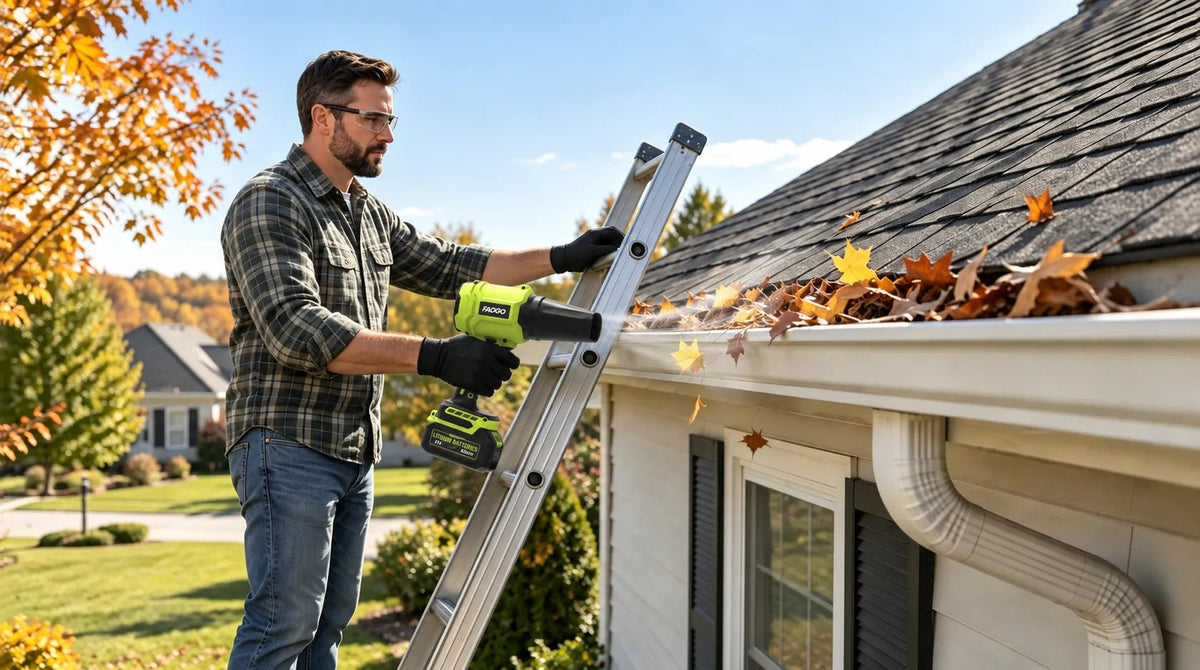
- Gutters and roofline: only if you're comfortable on a ladder. Blow the gutter line toward the downspout side, or toward the lawn, never toward the house.
- Flower beds and shrubs: use a low speed. Full power shreds the leaves into the mulch where they're nearly impossible to separate. Low speed nudges them out onto the grass.
- Driveway, walkways, and patio: fast to clear, satisfying to see, do these before the lawn so debris doesn't blow back onto it.
- The lawn: your last and biggest pass, pushing everything toward the downwind collection point.
Blow into a pile on a tarp, not a pile on the grass
This is the single biggest upgrade to my workflow. Lay out a tarp where the wind wants your leaves to go, blow everything onto it, then drag the tarp — leaves and all — to the curb, the compost area, or wherever they're going. You handle the leaves once instead of scooping them by armful into bags.
A 8×10 foot tarp holds about as much as six or seven paper lawn bags. Two tarp-loads handled my worst weekend of the season.
Technique: angle, distance, sweep
Three things I got wrong the first time out:
- Angle the airstream along the ground, not down into it. Pointing down just pins the leaves to the grass. Skimming at a shallow angle rolls them forward.
- Stay about a foot off the ground and sweep in arcs. A slow side-to-side sweep covers a wide path evenly. Holding the nozzle dead still just carves a stripe.
- Walk while you blow. The leaves should be moving at your walking pace the whole time. If you're standing still waiting for a pile to reach you, you've stopped working.
The wet leaves problem
Sometimes you can't wait for dry, and the lawn is a mat of soaked maple leaves. A few things help:
- Wait for the surface to at least stop dripping. Even two hours of afternoon sun takes soaked to merely damp, and damp is workable.
- Use short bursts instead of a continuous stream. A sustained blast on wet leaves digs a hole in the pile; pulses lift the top layer and get it moving.
- Work smaller sections. Move each batch a shorter distance rather than trying to drive a wet pile forty feet — the front of the pile stalls and the back piles onto it.
- A leaf rake still beats a blower on genuinely soaked mats. Keep one around for the corners where the blower gives up. It's not a character flaw.
What to do with the pile once you have it
| Option | Best for | Effort |
|---|---|---|
| Mow over it | Small amounts of dry leaves on the lawn — shredded pieces break down into the turf over winter and feed it | Lowest — no collection at all |
| Compost | If you have a bin or a back-corner pile; leaves are free brown material | Low — drag the tarp there |
| Curbside bags | Most municipal programs; check whether yours wants paper or plastic | Medium — some scooping involved |
| Leaf mold pile | Gardeners — waterlogged leaves left in a ring of wire fencing for a year make excellent soil conditioner | Lowest — pile and forget |
| Mulch for beds | Shredded leaves around perennials insulate roots over winter | Low — shred and spread |
A mulching mower honestly handles a shocking amount of leaf coverage. If the layer on your lawn is thin and dry, running the mower over it with the bag off can replace collection entirely. It stops working when the leaves are more than an inch or two deep, which around most deciduous trees is roughly mid-October.
Cadence: little and often beats heroic monthly marathons
Every week or ten days takes me 30 to 40 minutes now. Waiting three weeks turns it into a two-hour job, because leaves mat down, get rained on, and the pile at the bottom stops cooperating. The neighbors who do one massive cleanup in November all seem to have the same thousand-yard stare by the end of it.
Also — and I learned this the hard way — clear before the first hard frost if you can. Frozen wet leaves weld themselves to pavement, and you'll be chipping them off the driveway in March.
What didn't work
- Waiting for all the leaves to fall. Sounds efficient, means six weeks of a buried lawn and one miserable mega-job.
- A leaf vacuum. Fine for a patio. On a quarter-acre lawn, the collection bag fills every ninety seconds and you spend the afternoon walking back and forth to a compost bin. Sell it or gift it.
- Burning. Illegal in plenty of towns, annoying in all of them, and it takes hours for a pile that blows away in minutes. Check local rules before you even consider it.
- Borrowing a giant gas backpack blower. Unbelievable power, and after twenty minutes my ears were ringing and my arm was vibrating. Total overkill for a residential lot. The cordless handheld does the same job at a sane noise level, and at 2.8 lbs it doesn't wreck your wrists.
The tool I ended up with
After the neighbor demo sold me on the concept, I spent too long comparing options and landed on the FAOGO Cordless Turbo Fan. The short version of why:
- It's light enough to use one-handed. 2.8 lbs with an anti-slip grip. My arm doesn't give out mid-lawn the way it did with the borrowed backpack unit.
- Adjustable speed is the feature I didn't know I needed. Full power for the lawn and driveway, low speed for flower beds and around the mulch — same tool, two very different jobs.
- Two batteries cover a full session. Dual 21V 4.0Ah packs, one on the charger while the other runs. The motor holds consistent output too — no fade halfway through like cheaper units.
- It doubles as a car dryer in the summer. Same tool blows water off the car after a wash — the narrow nozzle gets water out of mirrors and trim without towels touching the paint. Two-season tool, one storage spot.
For what it's worth, it also handles light snow on the walkway and barbecue ash, which I did not buy it for but now use it for constantly.
Questions people actually ask me
Is a leaf blower really worth it for a small yard?
If your yard is a townhouse patch of twenty square feet, no — rake it, it takes ten minutes. Around a quarter acre with a couple of trees, the math changes fast. The first weekend you finish in under an hour instead of an afternoon, you'll understand.
How loud is it, really?
Noticeably quieter than a gas unit, and it doesn't have that two-stroke drone that carries three houses down. I run mine mid-morning without apology. Cordless electric blowers in general are far easier on neighbor relations than gas.
What about leaves stuck in the hedge?
Low speed, from above and to the side. Blasting straight into a hedge just lodges them deeper. An upward angle from below sometimes pops the stubborn ones out.
Can I blow leaves into the street?
Check your town's rules first — some fine you for it, some have vacuum trucks that expect it. Blowing into the street where a storm drain will catch them is a bad idea either way; clogged drains in November are nobody's friend.
When should I stop bothering?
After the trees are bare and you've done one final clear before the ground freezes. Anything after that is nature's mulch.
Clear the yard before lunch
FAOGO Cordless Turbo Fan — 980k RPM brushless motor, dual 21V batteries, adjustable speed, 2.8 lbs. Leaves, patio, gutters, car drying. One tool, no cords.
Check it out on FAOGO →Free shipping over $90 · 90-day free returns · Ships in 1-2 business days

Share:
12 Surprising Uses for a Cordless Turbo Fan (Beyond Drying Your Car)
Best cordless leaf blower 2026: a buyer's guide from someone who bought the wrong one twice