
September 2026 · 9 min read · Yard Maintenance
The rain stopped an hour ago and water is still spilling over the front gutter like a broken fountain. You can hear it from the driveway. That's not a roof problem — it's a clog, and it has been building since the leaves came down.
Every fall I told myself I'd deal with it, and every fall I found a reason not to, because the job is objectively awful: a ladder, a plastic scoop, and a trough full of decomposing leaf mush with the general character of swamp sludge. Two autumns ago I stopped scooping and started blowing instead. It worked — mostly. It also went badly wrong once, in a way that cost me a Saturday and a section of downspout, and the difference between the two outcomes came down to technique, not horsepower.
This is the guide I wish I'd had: why clogs behave the way they do, the seven techniques that decide whether blowing works or backfires, and the situations where you should honestly just pay someone.
First, figure out which kind of clog you have
Gutter clogs aren't one problem, they're three, and a blower only really solves one of them. Dig a single gloved handful out of the trough near a downspout and look at what comes up:
- Stage one: the dry bridge. Loose leaves have landed, overlapped, and matted into a raft, but they're still dry and crumbly underneath. This is what a blower eats for breakfast. If you catch it here, the job takes twenty minutes.
- Stage two: the wet compaction. Rain has soaked the mat and pressed it into a heavy, sticky layer of half-composted leaf material along the bottom of the trough. A blower moves patches of this at moderate-to-high speed, but mostly it smears. You'll get the top layers; the bottom layer needs either 48 hours of dry weather or a scoop for the worst sections.
- Stage three: the compost bin. The layer has been there long enough to start breaking down into soil. There are seedlings growing out of it. No amount of air speed fixes this — it's a gloved-hand job, and you should plan for it to take a full morning.
Blow early and you're doing air maintenance. Blow late and you're doing archaeology. The single biggest determinant of how easy this job will be is the date you start, not the tool you hold.
Why the usual methods are worse than you remember
Hand-scooping works, but it's slow, it's gross, and every extra minute on a ladder is statistical risk you're accruing for a chore. A pressure washer clears gutters fast and is genuinely good at downspout blockages, but at close range it can separate seams on older sectional gutters and it paints your siding with whatever was in the trough. The garden-hose-from-the-ground trick only reaches first-floor eaves and mostly relocates the problem.
A leaf blower, used with a bit of technique, is the fastest safe option for stage one and most of stage two. Used carelessly, it will ram debris into your downspout and turn a ten-minute clog into a two-hour one. Here is the version that doesn't do that.
The seven techniques that decide whether this works
1. Angle the airflow along the trough, never into it
The mistake I made the first time: I stood at the end of a run and fired straight down the trough at full power, treating it like the world's narrowest driveway. The dry leaves at the far end had nowhere to go but down the downspout, which packed it solid, and the section I ended up paying a plumber's snake to clear.
What works instead: hold the nozzle at roughly 45 degrees to the trough line and work in short, angled strokes, herding debris along the gutter toward an open end where you can pull the pile out by hand. You're sweeping, not pressure-washing. The pile consolidates, the downspout stays clear, and the handful you remove at the end is the whole job.
2. Speed control is the whole game
Full throttle feels productive and is the fastest way to make things worse. Medium speed on dry leaves moves them in long, controlled strokes. High speed is only for damp patches that resist the medium setting, applied in bursts, aimed away from the downspout opening.
This is where single-speed blowers fail at gutter work and adjustable ones earn their keep: the job is mostly done at half power, and the one-speed units I've used were either too weak at their only setting to matter or strong enough to make the downspout mistake on every pass.
3. One-handed weight is a hard limit
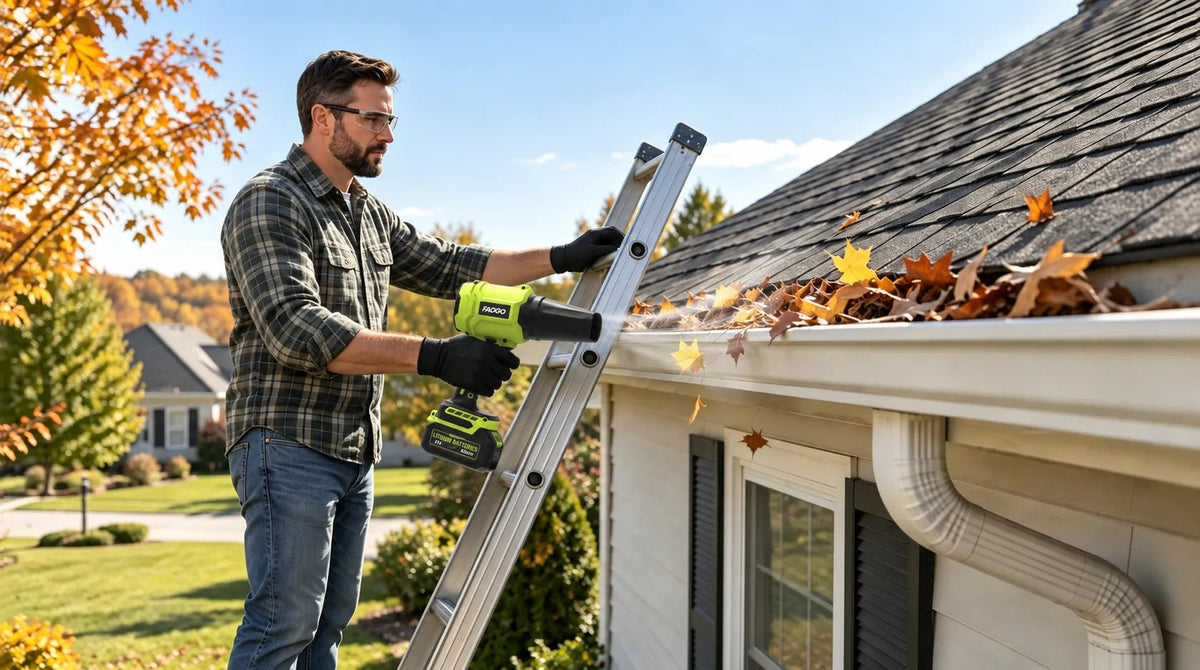
On a ladder you have one hand for the tool and one for the ladder. That's non-negotiable. Anything over about four pounds with the battery inserted becomes a wrist-control problem within ten minutes, and a control problem on a ladder is a safety problem. The under-three-pound class — the 2.8 lb range — lets you work an entire single-story perimeter one-handed without your grip degrading. The seven-pound 40V backpack-style units are magnificent lawn tools that have no business on rung six of an extension ladder.
4. Check for tenants before you blow
Tap the trough with a stick and look before the first blast. In October, downspouts and deep leaf layers are popular wintering spots for wasp queens, and discovering this with a jet of air pointed at your own face is a memorable experience I can personally recommend against. Grit, shingle granules, and dust also come back at you; safety glasses are a two-dollar decision that pays for itself the first time.
5. Work the wind, not against it
Check which way the breeze is blowing before you start, and position the ladder so the debris cloud goes away from you, away from the house's open windows, and away from the car you left in the driveway because you were "just going to be twenty minutes." The voice of experience.
6. Two-story houses: the ground game
Do not take a ladder to a second-story gutter alone, and don't stand on the roof to do it — a wet or mossy roof in October is one of the most genuinely dangerous surfaces around a house. Your options, in descending order of sanity:
- An extension wand. Universal gutter-cleaning tubes attach to many handheld blowers and let you work second-story troughs from the ground. If you go this route, check the nozzle diameter of your blower against the wand's fittings before buying — they're not all interchangeable.
- A pro for the high sections, blower for the low ones. This is the split I've settled on. The first floor takes me half an hour with the blower; a service does the second floor once a year for about the cost of a dinner out.
- Upward angled bursts from the ground for the reachable front edge of low second-story runs. Works marginally on dry debris, and only when there's been no rain for days.
7. Finish with the 60-second water test
When the trough looks clear, run a gentle stream of water from a garden hose at the far end and watch it travel. If it pools anywhere, you either missed a patch or the downspout itself is blocked — and a blocked downspout is a snake-or-hose-from-the-bottom job, not a blowing job. While you're up there, glance at the gutter's pitch and the hanger spikes: a trough that's pulling away or holding standing water in a specific spot will clog faster there all season, and that's a five-minute fix now versus a recurring headache until it's corrected.
The honest safety section
Ladder falls send hundreds of thousands of Americans to emergency rooms every year, and gutter cleaning is near the top of the list of activities that put them there. The rules that matter:
- Never on a wet or mossy roof. Not "carefully," not "just the edge." No.
- The 4-to-1 rule: for every four feet of ladder height, the base sits one foot from the wall.
- Three points of contact on the ladder at all times, which is exactly why the blower has to be one-handable.
- Someone home. A ladder, a phone in your pocket, and a family member who knows where you are.
- If your palms sweat thinking about the ladder, that's your answer. Genuinely. The money a pro charges — typically $100 to $250 for an average house — is less than most ER copays, and there is no blog post worth a broken wrist.
How often should gutters actually be cleaned?
It's a function of what's over your roof, not a fixed calendar:
- Heavy tree cover (oaks, maples, pines within dropping distance): twice a year minimum — once after the main leaf fall in late fall, once after the spring seed drop. Maple helicopters and pine needles are worse than leaves because they slide straight into downspouts.
- Light cover or open exposure: once a year, late fall, after the trees are bare. Doing it before the trees are done dropping just means doing it twice.
- After any significant storm that's blown through when you're already near the end of your interval — storms do a season's worth of loading in an afternoon.
The late-fall cleaning is the one that matters most. A gutter that goes into winter holding leaves becomes a gutter holding frozen leaves, and frozen blockages cause ice dams — which is a repair bill in a different league from any of this.
DIY blower vs. scoop vs. hiring out
| Blower (DIY) | Hand-scooping | Pro service | |
|---|---|---|---|
| Cost | $0 if you own the tool | $0 + scoop and gloves | $100–250 per visit |
| Time, single story | 30–60 min | Half a day | None of yours |
| Dry leaf clogs | Excellent | Slow but works | Excellent |
| Wet/compacted debris | Partial — needs dry weather or follow-up scooping | The only real option | Handled |
| Second-story reach | Extension wand only | Full (with risk) | Full |
| Ladder risk | Reduced by speed, not eliminated | Highest | Transferred |
For a single-story house with ordinary tree cover, the blower turns an all-Saturday chore into an hour before lunch. For two stories, heavy stage-two debris, or anyone for whom the ladder is the problem rather than the tool, the professional is not an admission of defeat — it's the correct tool for the job.
What the tool needs to be good at this
Since I've now used three different blowers on gutters across four falls, here's what the job actually demands from the spec sheet:
- Under 3 lbs with the battery in. One-handed ladder work is the entire method; weight is the limiting factor.
- Adjustable speed. You'll do 80% of the job at medium power, and you need the discipline to stay there.
- A narrow nozzle. Air focused into the trough moves debris; a wide-open tip scatters it into your face and the flowerbeds. A narrow precision tip also reaches under gutter hangers where the worst compaction forms.
- Air speed around 110 mph. Below roughly 100 the damp patches won't budge; you don't need much more than 110 for residential gutter work.
- Swappable or dual batteries. A single-story perimeter takes 15 to 25 minutes of trigger time — one battery is marginal, two covers it with room to spare.
The FAOGO Cordless Turbo Fan was what converted me to this method, and the reasons are exactly the list above: 2.8 lbs with the battery in, multi-speed trigger, narrow precision nozzle included, 110+ mph of air speed, and two 21V 4.0 Ah packs that swap mid-job. What it won't do, in the interest of honesty: it won't replace a scoop on stage-three compost, it doesn't ship with a factory extension wand for second-story work (aftermarket universal wands exist — check the nozzle diameter first), and if your situation calls for a pro, no handheld tool changes that math.
One tool for the gutters, the lawn, and the car
FAOGO Cordless Turbo Fan — 980,000 RPM motor, 110+ mph air speed, dual 21V 4.0 Ah batteries, 2.8 lbs with battery in. Adjustable speed, narrow precision nozzle included. Clear the gutters Saturday morning, dry the car Saturday afternoon. If it doesn't earn its spot in your garage, send it back within 90 days for a full refund.
See it on FAOGO →Free shipping over $90 · 90-day free returns · Ships in 1-2 business days
FAQ
Can you really clean gutters with a leaf blower?
Yes, for dry to moderately damp debris — which is most clogs if you get to them within a few weeks of leaf fall. It's the fastest safe method for single-story homes. Fully soaked or composted debris won't blow; it smears, and those sections need a scoop regardless of your tool.
How do I know my gutters are clogged before I see a waterfall?
The early signs: water overshooting the gutter edge during rain, streaks or green stains on the siding below the gutter line, the gutter sagging or pulling away at one section, plants growing out of the trough, and mosquitoes congregating near the roofline — they breed in the standing water a blockage creates.
What time of year should gutters be cleaned?
Late fall, after the trees are bare, is the critical one — before snow and ice turn the debris dam into an ice dam. A second pass after the spring seed drop if you have maples or pines nearby. Any time you see the overflow signs, that's the schedule telling you it's now.
Do leaf blower gutter attachments actually work?
On the right debris, yes. An extension wand lets you work second-story troughs from the ground, which removes the ladder from the equation entirely. Two caveats: they're tiring to aim precisely after twenty minutes because you're holding the tool's weight on a long lever, and fitting compatibility varies by brand — check the nozzle diameter before ordering.
How much does professional gutter cleaning cost?
Typically $1 to $2 per linear foot of gutter, which works out to $100–$250 for an average single-family home, more for two stories or steep roofs. Many services bundle a downspout flush and a visual check of the roof into the same visit.
Is it dangerous to clean gutters yourself?
The ladder is the danger, not the gutters. Done from a stable ladder at 4-to-1, with three points of contact and someone home, a single-story gutter cleaning is a routine chore. From a roof, or a wet ladder, or alone on a second-story climb, the risk rises fast — and the $150 you're saving is not the bet it looks like.

Share:
Best cordless leaf blower 2026: a buyer's guide from someone who bought the wrong one twice