
September 2026 · 11 min read · Buying Guides
The first cordless leaf blower I bought was a 40-volt unit from a brand I trusted because my dad had one. It weighed 7.4 pounds with the battery. By the time I'd finished the front lawn my wrist was sore, my back was in protest, and the battery was at 14 percent. That was 2019. I sold it the next spring.
The second was a cheap one off Amazon that promised "professional power" and arrived looking like a toy. It moved dry leaves, sort of, in a stiff breeze, if I held it at exactly the right angle. I kept it three months.
The third one I've now had for two full fall seasons and used enough that I have opinions. This is the guide I wish existed before either of the first two purchases: not a list of "top 10" units I haven't actually held, but the seven parameters that matter, how to match them to your specific yard and your body, and a frank read on which situations each type of cordless blower is actually built for.
The 7 parameters that actually matter (skip the rest)
Every product page lists fifteen specs. Most of them are noise. Here is the short list — every other comparison is downstream of these:
- Air speed, not RPM. Manufacturers love the big "200,000 RPM" headline number. What actually moves a leaf is the air speed coming out the nozzle, measured in m/s or mph. Below 100 mph the unit struggles with damp leaves and anything heavier than maple. 110+ mph handles most residential jobs without complaint.
- Weight with the battery in. A handheld you use for twenty minutes is not the same tool as one you use for two. Anything over 4 pounds becomes a wrist exercise by minute ten. Under 3 pounds is the sweet spot for one-handed use without fatigue.
- Battery, not voltage. "20V max" and "40V" are marketing. What matters is the actual amp-hour (Ah) rating of the pack. A 4.0 Ah pack at 21V gives you roughly twice the runtime of a 2.0 Ah at the same voltage. Two batteries you can hot-swap is meaningfully better than one big battery that takes an hour to charge.
- Speed control. Single-speed blowers are for people who only ever do one job. Adjustable speed is what lets you go from full power on the lawn to low power around flower beds without shredding the mulch. It is the single most under-rated feature on the spec sheet.
- Nozzle design. A wide nozzle moves more volume but is sloppy around tight spots. A narrow precision nozzle gets water out of mirror mounts and leaves out of hedge bottoms. The serious tools ship with both, or with a swappable tip.
- Charge time. A dead battery in the middle of a Saturday is its own kind of misery. Some packs need 90 minutes. The better designs are under 60. The best run the second pack while the first charges.
- Return policy. Sounds boring until you need it. 30 days is standard. 90 days means you can actually use the unit through a full fall season and return it if your wrist or your yard disagrees. This is the spec sheet line that tells you the brand is confident in the tool.
That is the whole list. Every buying decision below flows from how these seven numbers interact with your specific situation.
Match the tool to your situation, not the other way around
The biggest mistake first-time buyers make is picking the unit with the biggest numbers, then wondering why it feels wrong in the yard. A 600-CFM gas backpack on a 400-square-foot patio is overkill. A 60-mph compact unit on a wet oak-leaf Saturday is a paperweight. The right tool is the one that fits the actual job, your actual hand, and your actual tolerance for noise.
Five situations I have either lived through or watched a friend fight through. Your situation will not match any of them exactly, but one of them will be close.
Situation 1: Apartment balcony, small patio, or under 500 sq ft
You don't really need a leaf blower. A stiff broom and a dustpan take ten minutes and cost nothing. If you do want one — for blowing out a car, drying off a wet welcome mat, clearing a balcony after a windy night — what you need is a tiny 12V or 18V handheld, under 2.5 pounds, single speed, under 50 mph of air. Something you can keep in a closet.
A high-power 980k-RPM tool here is genuine overkill. It is louder than the building next door wants to hear at 9 AM, and you will use maybe 5 percent of its capability. You would be paying for a sports car to drive to the corner store.
The honest read: skip the dedicated tool entirely. A small cordless handheld under $40 from any hardware brand will cover this and tuck into a kitchen drawer. If you also own a car and a vacuum, the case for a real tool strengthens — see situation 5.
Situation 2: City single-family home, quarter-acre lot, two trees
This is the most common residential scenario in the US, and the one almost every cordless blower on the market is designed for. The job is leaves on the lawn, debris on the driveway, dust in the garage, and clearing a small patio in under 30 minutes. You will run the tool 20 to 40 minutes a week during fall, less in summer.
What you need: at least 100 mph of air, ideally 110+, with adjustable speed. Weight under 3 pounds so a 40-minute session doesn't end in a wrist brace. Battery runtime of at least 20 minutes per pack, and ideally two packs so you can hot-swap. Charge time under an hour.
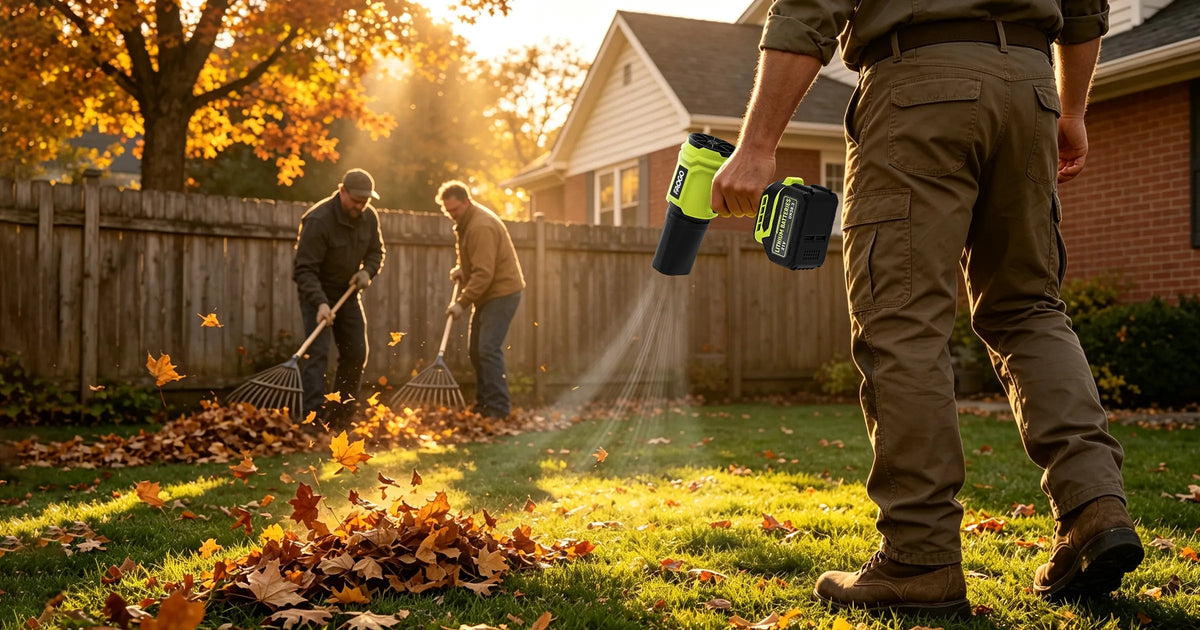
This is exactly the scenario where a unit like the FAOGO Cordless Turbo Fan was designed to live. 110+ mph air, 2.8 lbs with battery in, dual 21V 4.0 Ah packs giving you 13 minutes each and 26 minutes total, adjustable speed for the lawn versus the flower beds, and a narrow nozzle for the driveway edges. I am not pretending to be neutral here — this is the unit I ended up with after the two bad purchases — but it is also a scenario where a lot of competing units genuinely work fine. The reason I keep this one is the weight-and-battery combination, not the headline RPM number.
Situation 3: Suburban or rural, half acre plus, heavy leaf drop, mature trees
You are no longer in "weekend chore" territory. You are in "Saturday is leaf day, no matter what" territory. Three to five mature trees, a lawn that disappears under a two-inch layer by mid-October, possibly a long gravel driveway that collects every leaf in the neighborhood.
What you need: this is where a cordless handheld starts to strain. A 26-minute runtime is a quarter of the job. You will spend the second half changing batteries, walking back to the charger, and standing around. The honest answer for this scenario is a gas backpack blower or a 60V+ cordless system with multiple large batteries. Not a 21V handheld.
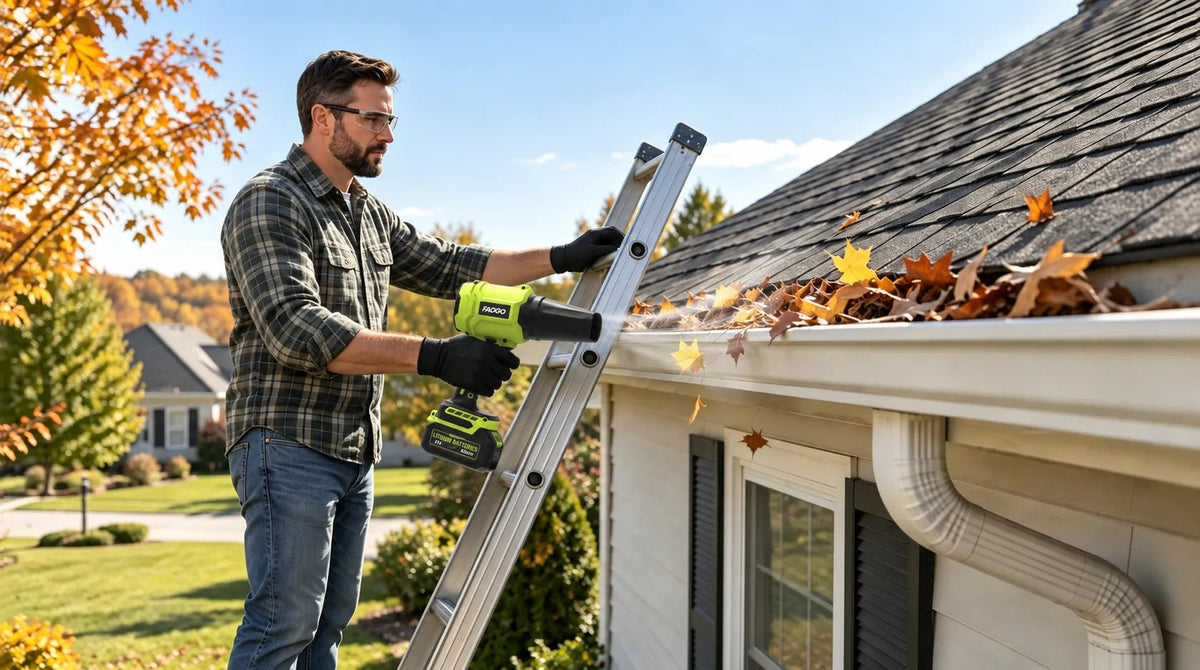
That said — and this is the part most buying guides skip — a 21V handheld still earns its place as a complement to a bigger tool, not a replacement. Use the gas or high-voltage unit for the main lawn passes. Use the lightweight cordless for the second-story gutters, the porch corners, the garage interior, the car, and the places the loud backpack is overkill. Two tools, two jobs.
If you refuse to own two tools, the math changes. A heavy 60V unit at 8+ pounds is not fun for an hour, and the noise will get you in trouble with the neighbors. But the runtime will cover the work.
Situation 4: Older user, joint pain, or anyone who values one-handed comfort
A surprising number of buyers in their 50s, 60s, and beyond want a leaf blower for the same reason everyone else does — to avoid the rake — but their wrists, shoulders, or grip strength won't tolerate a 7-pound unit. My dad is in this category, and watching him try to wrestle a heavy corded unit for ten minutes is the reason I take weight seriously.
What you need: under 3 pounds with battery, ideally under 2.5. An ergonomic anti-slip handle so it doesn't try to rotate in the grip. Variable speed so full power is one trigger pull away, not a default. A balanced center of gravity — the battery should not make the front end dive.
A unit in the 21V 4.0 Ah class typically lands at 2.5 to 3 pounds and checks all three boxes. The bigger concern in this scenario is not the tool itself, it is the task: if the user is clearing an entire half-acre lawn, no handheld will save their shoulder. The right answer is shorter sessions, more often, and let the rake take the corners the blower doesn't reach gracefully.
Situation 5: Renter, multi-tasker, or "I want one tool that does several things"
This is the FAOGO-shaped scenario, and I'll say so plainly. If you live in an apartment with a parking spot, drive a car, occasionally camp or tailgate, want to clear a small patio, dry the car after a wash, blow out a keyboard, and don't have garage space to store four tools, the calculus is different. You don't want the most powerful leaf blower. You want the most useful one tool.
A 110+ mph cordless unit that weighs 2.8 pounds and runs 26 minutes on dual batteries does all of the above. It blows leaves. It dries a car without scratching the paint. It clears dust from a keyboard. It blows ash off a grill. It inflates an air mattress. It will not do all of these as well as a purpose-built tool for each job — no single tool ever does — but for someone with limited storage and limited patience for owning eight things, it is the most flexible option in the category.
The other thing this scenario rewards is a generous return window. A 90-day return policy means you can buy it, use it for the first three fall weekends, and send it back if the weight bothers your wrist or the air isn't enough for your specific yard. You are not betting $100 on a hope; you are trying the tool through a real season.
The three mistakes I made on my first two purchases
None of these are obvious from a product page. All of them are obvious in hindsight.
Chasing RPM instead of air speed. A 200,000 RPM motor in a poorly designed housing moves less air than a 100,000 RPM motor in a properly shaped nozzle. RPM is what the motor can do. Air speed is what the leaf actually feels. I never looked at the second number on either of my first two purchases, and I paid for it in leaves that did not move.
Believing the "40V" sticker. My first blower was a 40V system. The pack was 2.0 Ah, which meant real-world runtime of maybe 12 minutes, after which the voltage sag made the unit feel half as powerful as the sticker promised. Voltage is the headline. Amp-hours are the truth. I now check the Ah rating before I check anything else.
Ignoring the return policy. My second purchase was non-returnable after 15 days. By the time I understood I had made a mistake, the window was closed. A leaf blower is a physical tool, and the only way to know if it suits your hand and your yard is to actually use it. 30 days is the minimum. 60 to 90 is the comfortable range. Anything shorter and you are gambling.
Quick recommendation by situation
| Your situation | Look for | Skip if |
|---|---|---|
| Apartment / balcony / under 500 sq ft | Sub-2.5 lb compact, single speed, under 50 mph | Anything over $60 is wasted |
| Quarter-acre residential | 21V 4.0 Ah dual-battery, 110+ mph, under 3 lbs, adjustable speed | Single-speed, no second battery |
| Half acre plus, heavy leaf drop | 60V+ system or gas backpack, plan for 60+ min runtime | A 21V handheld as the only tool |
| Joint pain or older user | Under 2.5–3 lbs, anti-slip grip, variable speed | Anything over 3.5 lbs |
| Renter or multi-use | Lightweight cordless, 90-day return, multi-nozzle | Heavy single-purpose tool |
My honest short answer
For a typical quarter-acre lot, a 21V cordless unit with two 4.0 Ah batteries, adjustable speed, and a sub-3-pound weight is the right answer for about 80 percent of buyers. The specific model matters less than hitting those four marks. I have used the FAOGO Cordless Turbo Fan for two fall seasons and one full summer of car-drying, and it is the tool I reach for first, ahead of the broom, the microfiber, and the air compressor in the garage. That is the highest compliment I can give a piece of equipment: it displaced other tools that should, in theory, be better at their specific job.
If your situation is bigger, lighter, or more specialized than the typical quarter-acre, the recommendations above walk you through the trade-offs. The wrong answer is almost always either too heavy for the job, too weak for the leaf load, or backed by a return policy too short to actually try it.
Questions people ask before buying
How many mph do I actually need for fall leaves?
100 mph is the minimum for dry leaves on a hard surface. 110+ is the comfortable number for damp leaves, leaf piles, and any of the heavier maple and oak drop. Anything advertised as "200 mph" is almost always a peak number at the nozzle with no load, not a working number on a wet oak leaf.
Is brushless motor worth the extra cost?
For a tool you use weekly through fall, yes — the motor runs cooler, holds output under load, and lasts longer. For a tool you use three times a year on the patio, a brushed motor is fine. Don't pay 40 percent more for "brushless" if you're not putting the tool through real work.
Single battery or dual?
Dual. Always. The math is straightforward: a 21V 4.0 Ah pack gives you about 13 minutes of full-throttle runtime. A single pack is 13 minutes total. Two packs let you hot-swap and double your working time, which is the difference between finishing the yard and stopping at the 70-percent mark to wait for a recharge.
Can I use a cordless leaf blower in the rain?
The unit is sealed against incidental water, but blowing wet leaves while it's actually raining is bad for two reasons: the leaves mat down instead of moving, and you are holding a powered tool in a wet hand. Save the rain-day cleanup for a dry window.
How loud is a cordless blower compared to gas?
A typical cordless unit is in the 65–75 dB range at the operator's ear. A gas backpack is closer to 90. The difference is enormous in practice — you can hear someone talking three houses away with a gas unit running, and you can have a phone conversation next to a cordless unit on low speed.
What if I want to use it for the car too?
This is the underrated secondary use. A narrow precision nozzle at moderate speed pushes water out of mirror mounts, door handles, and trim gaps without touching the paint. The same tool that handles your fall leaves handles your summer car-drying. Make sure the unit you buy has a swappable or narrow nozzle included, and check the product page for any car-detailing guidance.
Try the 90-day test drive
FAOGO Cordless Turbo Fan — 980,000 RPM motor, 110+ mph air speed, dual 21V 4.0 Ah batteries, 2.8 lbs with battery in. Adjustable speed, narrow precision nozzle included. Use it through a full fall season. If it doesn't fit, return it for a full refund.
See it on FAOGO →Free shipping over $90 · 90-day free returns · Ships in 1-2 business days

Share:
Fall yard cleanup: how I cut my leaf clearing time by two-thirds
How to clean gutters with a leaf blower (without making the clog worse)